

#5 How to Find Your Product's Natural Frequency: The 5+2-Step Use Case Framework


How do you actually figure out the nature of your specific product? Most teams guess. They look at competitors, run a few interviews, and call it a day. But there's a better way — a structured method for defining the natural frequency of any product by understanding who your user is, what problem they're solving, and how often that problem genuinely shows up in their life.
It's called the Use Case Framework, and it has five steps. To make it concrete, I'll walk through each one using a product I know intimately as a power user: Chess.com, the world's largest online chess platform and community with over 250 million users. I've played chess for years and paid for a Chess.com subscription, so I know exactly why people keep coming back.
Step 1: The Problem
Start by defining the specific pain point or desire — and crucially, do it in the user's own words. Not marketing language. Not a feature list. The actual sentence a real person would say out loud.
For Chess.com, it sounds something like this: "I want to play chess against real humans, test my skills, see how I rank, and stop making the same stupid mistakes."
Notice how specific and emotional that is. It's not "improve at chess." It's the frustration of repeating blunders, the curiosity about ranking, the desire for real opponents. That texture matters.
Step 2: The Persona
Next, ask: who experiences this problem most intensely? Not who might use the product — who feels the pain so sharply that they'll seek out a solution.
Chess.com's sweet spot is what I'd call the Aspiring Improver: typically 18 to 44 years old, competitive by nature, and borderline obsessed with their numeric ELO rating. This person doesn't just want to play chess. They want to watch a number go up.
Step 3: The Motivation
Why does this person pick your solution over every other option? What's the specific pull?
For Chess.com, it comes down to two things. First, a massive player pool — large enough that you get instant matchmaking at any time of day or night. Second, the game analysis tools, which tell you exactly where you blundered and what you should have played instead. Together, these turn every game into both entertainment and a feedback loop for improvement.
Step 4: The Alternatives
What would this person do if your product didn't exist? This is the question most founders skip, and it's a mistake. Your real competition isn't always who you think it is.
If Chess.com vanished tomorrow, the Aspiring Improver wouldn't quit chess. They'd head to a local chess club, switch to Lichess, or just play against the computer alone at home. Knowing this shapes everything — pricing, positioning, the features you double down on.
Step 5: The Frequency
This is the step that ties everything together: how often does this problem naturally occur?
For a serious chess player, the answer is daily to weekly. They're playing multiple blitz games during a lunch break, or sitting down for a rapid game every evening to unwind. That natural cadence isn't something the product creates — it's something the product serves.
And that frequency is the North Star for everything that follows: retention models, notification strategy, monetization, content cadence, even the onboarding experience. Get the frequency right, and the rest of your product strategy has somewhere solid to stand.
Defining Your Core Metric
Once you know the frequency, you need to turn it into a number — a retention metric you can actually track. This is where the framework moves from strategy to measurement.
Before we get into the mechanics, it's worth noting that SaaS products generally fall into three categories: habitual products that users return to constantly, utility products they reach for when a specific need arises, and B2B products tied to work cycles. The right metric depends on which category you're in, but the process for finding it is the same.
Step 1: Define the Core Event
Your core metric should capture the moment when the user experiences the product's core value. Not when they log in. Not when they open the app. When they actually extract the value they came for.
For Chess.com, that's a game played. For Airbnb, it's a completed vacation. For Zillow, a house sold. For Netflix, total hours watched. The event matters because it's what separates a retained user from someone who just showed up — opening the app and bouncing isn't retention, it's noise.
Step 2: Validate the Frequency
Now you check your assumption against reality. Build a frequency histogram: plot how many days out of the last 28 each user performed the core action, and see where the data clusters.
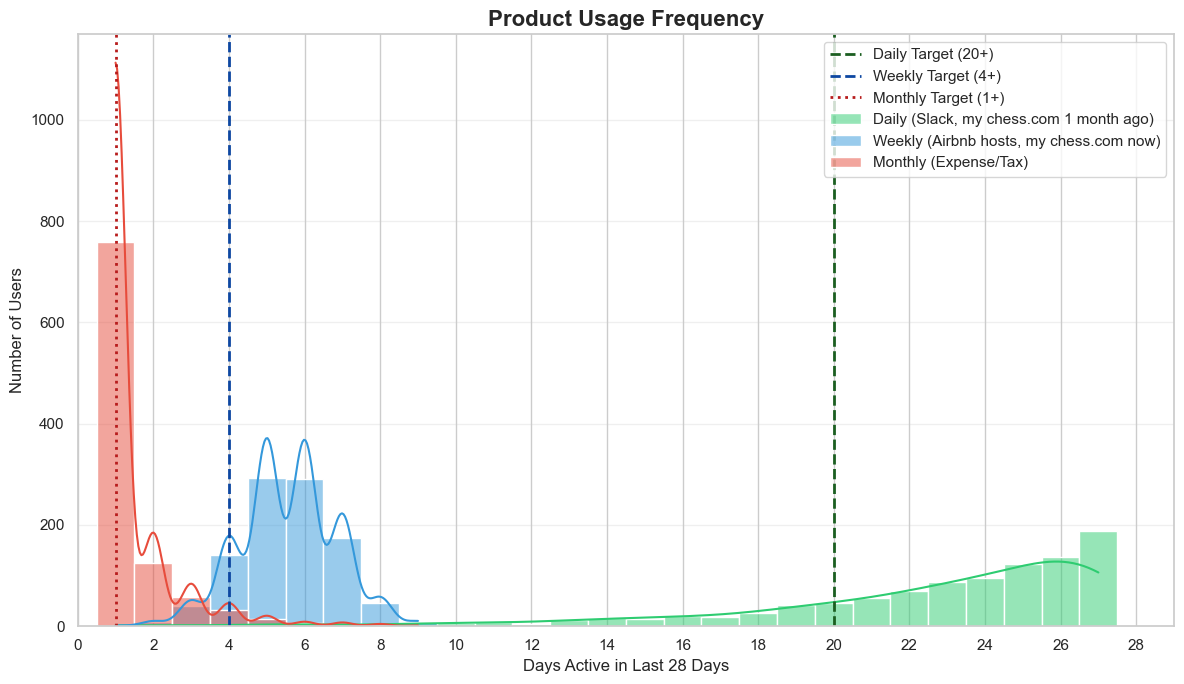
If it clusters on the far right — around 20 or more days — you're looking at a daily habit. If it sits in the middle, around 4 to 8 days, it's a weekly rhythm. If it piles up on the far left at 1 to 3 days, you're dealing with a monthly product.
Here's where it gets interesting. If the data says your users are only showing up monthly, but you believe the underlying problem is weekly, that gap isn't a measurement issue — it's a value gap. It means users aren't finding enough reason to come back as often as the problem actually occurs in their lives. And that's not something to explain away. It's something to fix.
The Use Case Framework works because it forces you to stop thinking about your product in the abstract and start thinking about a specific human, with a specific problem, that recurs at a specific rhythm. Once you can fill in all five steps with confidence — and back them up with a core metric that matches reality — you stop guessing. You start building for the natural frequency that's already there.
No spam, no sharing to third party. Only you and me.