

#2 How Retention Drives the Entire Growth Engine


In Part 1, we explored what retention really means and how to measure it without fooling yourself — from choosing the right time window and heartbeat event, to reading cohort triangle charts that reveal what's actually happening beneath the averages.
But measuring retention correctly is only half the story. The real question is: why does retention deserve so much attention over other growth levers? The answer is that retention doesn't just keep users around — it reshapes your entire growth engine. It compounds acquisition, monetization, competitive advantage, and cash flow simultaneously.
In this article, we'll use the concepts of LTV, CAC, payback period, and payback tolerance to show exactly how.
Key Concepts
Lifetime Value (LTV) = total gross profit you expect to earn from a customer over their lifetime.
Customer Acquisition Cost (CAC) = what it costs to acquire that customer.
LTV:CAC ratio answers: over the full lifetime of a customer, how much value do you get back for every dollar spent to acquire them? If LTV = $120 and CAC = $30, then LTV:CAC = 4:1. This is a long-term efficiency metric — it shows whether your growth model works over time, not whether it works fast enough.
Payback period answers: how long does it take for cumulative gross profit from a customer to repay the CAC? If CAC = $30 and monthly gross profit = $10, payback = 3 months. This is a time-based efficiency metric. Two companies can have the same LTV:CAC ratio but radically different growth trajectories depending on how quickly they pay back.
Payback tolerance is a strategic constraint, not a property of the business itself. It answers: what is the maximum payback period we're willing to accept? How much risk and delay can we absorb?
- Early-stage, cash-constrained startup → 3–6 months
- Public SaaS with strong cash flows → 12–24 months
- Venture-backed growth-at-all-costs phase → higher tolerance
How They Fit Together
1. LTV:CAC sets the ceiling. It tells you whether acquiring customers is profitable at all. Below 1, the model is unsustainable. Around 3–5, generally healthy. Very high? You may be under-investing in growth.
2. Payback period determines speed. It controls how fast capital recycles. Short payback means faster reinvestment and faster growth. Long payback means slower growth and higher capital risk.
This is why retention is so powerful: better retention → higher LTV + faster revenue accumulation → shorter payback.
3. Payback tolerance links economics to strategy. It converts unit economics into operational decisions: How high can CAC go? Can we add a new distribution channel? How fast can we scale spend?
Now let's look at the four specific ways retention drives growth.
Reason One: Retention Drives Your Acquisition Loop
Acquisition loops are self-reinforcing, cyclical systems in which user actions generate more users, driving compounding growth — unlike linear funnels. They work by turning product output (user activity, content) into input for new customer acquisition through referrals, user-generated content, viral sharing, or paid incentives.
Retained users fuel these loops. In viral products, they send more invites (LinkedIn, Slack, Dropbox, Instagram). In content-driven products like Pinterest, Houzz, and Yelp, they create more content that attracts new users through search. In paid acquisition models, higher retention increases profit per cohort, allowing faster reinvestment into ads. In B2B, retention finances sales and hiring, making growth more predictable.
Even small improvements compound. A modest lift in retention can dramatically increase the number of users generated from the same initial cohort over time.
Reason Two: Retention Drives Monetization
Users who stay longer generate more opportunities to monetize — through subscriptions, ads, transactions, or expansion. Longer lifetimes mean higher LTV, often without changing pricing or acquisition.
Across business models, the pattern is consistent. In advertising products like Facebook or Pinterest, retained users generate more ad inventory. In subscription businesses, they keep paying longer. In transactional models like Uber or e-commerce, they make more purchases. In freemium products like Spotify or Mailchimp, retaining free users creates more upgrade opportunities over time.
The simulation that proves it. To see these compounding effects in action, I built a deterministic growth engine to simulate a real-world digital platform. I initialized the model with a stable baseline of 1,500 users and 250 new signups per week, aiming for roughly 40% annual growth. At the 20-week mark, I introduced three experimental scenarios:
- Marketing Strategy: Increased weekly signup volume by 10%.
- Monetization Strategy: Increased signup-to-subscribe rate by 10% (from 40% to 44%).
- Retention Strategy: Increased retention of existing users by just 2% (weekly rate from 86% to 88%).
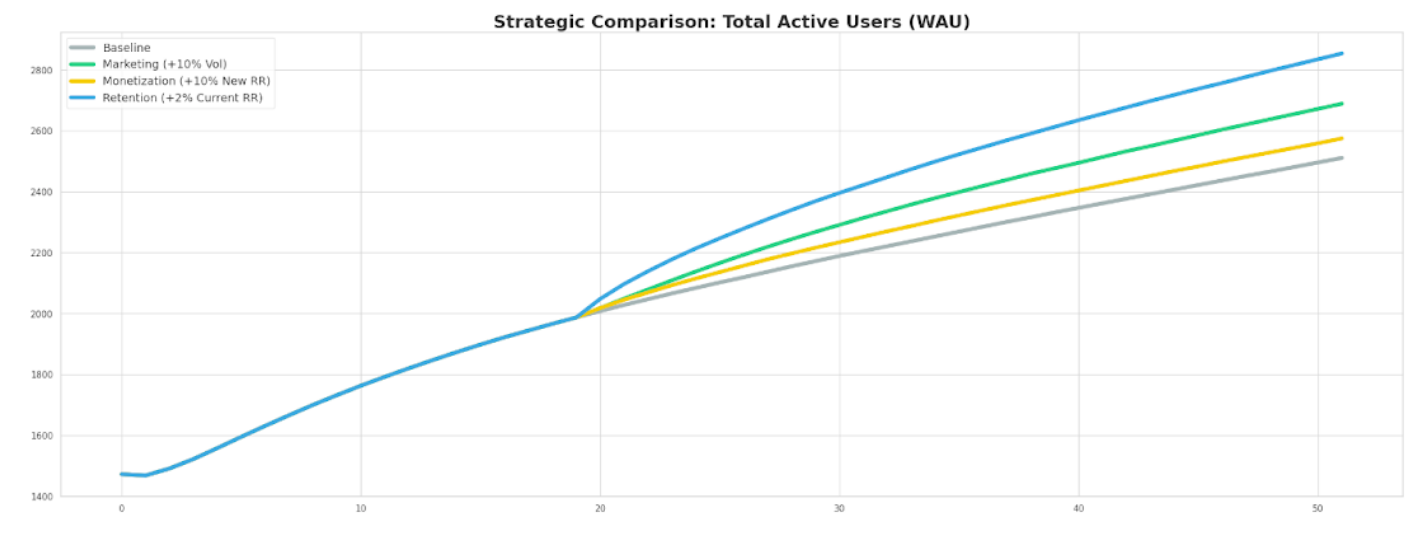
The results were definitive. While the marketing jump provided an immediate increase in active users, it also drove a proportional increase in dormant users — the system's outflow. Monetization proved more efficient than baseline by converting a higher share of existing signups. But the retention scenario outperformed every other lever by a significant margin over the long term.
Even with a much smaller absolute lift (2% for retention vs. 10% for marketing and 4% for monetization), the power of compounding on the existing 1,500-user base pulled the retention curve ahead by year-end.
By year-end, the retention strategy didn't just win — it dominated. Despite having the smallest percentage increase, it generated 343 additional users over baseline — nearly double the marketing push (+178) and over five times the monetization effort (+64).
The strategic equivalency comparison made the disparity even starker. To match a mere 2% retention increase, you'd need to increase marketing signup volume by 131%. For monetization, even optimizing the signup-to-subscribe rate to a near-perfect 95% couldn't bridge the gap — the lack of compounding on the existing base makes it mathematically impossible.
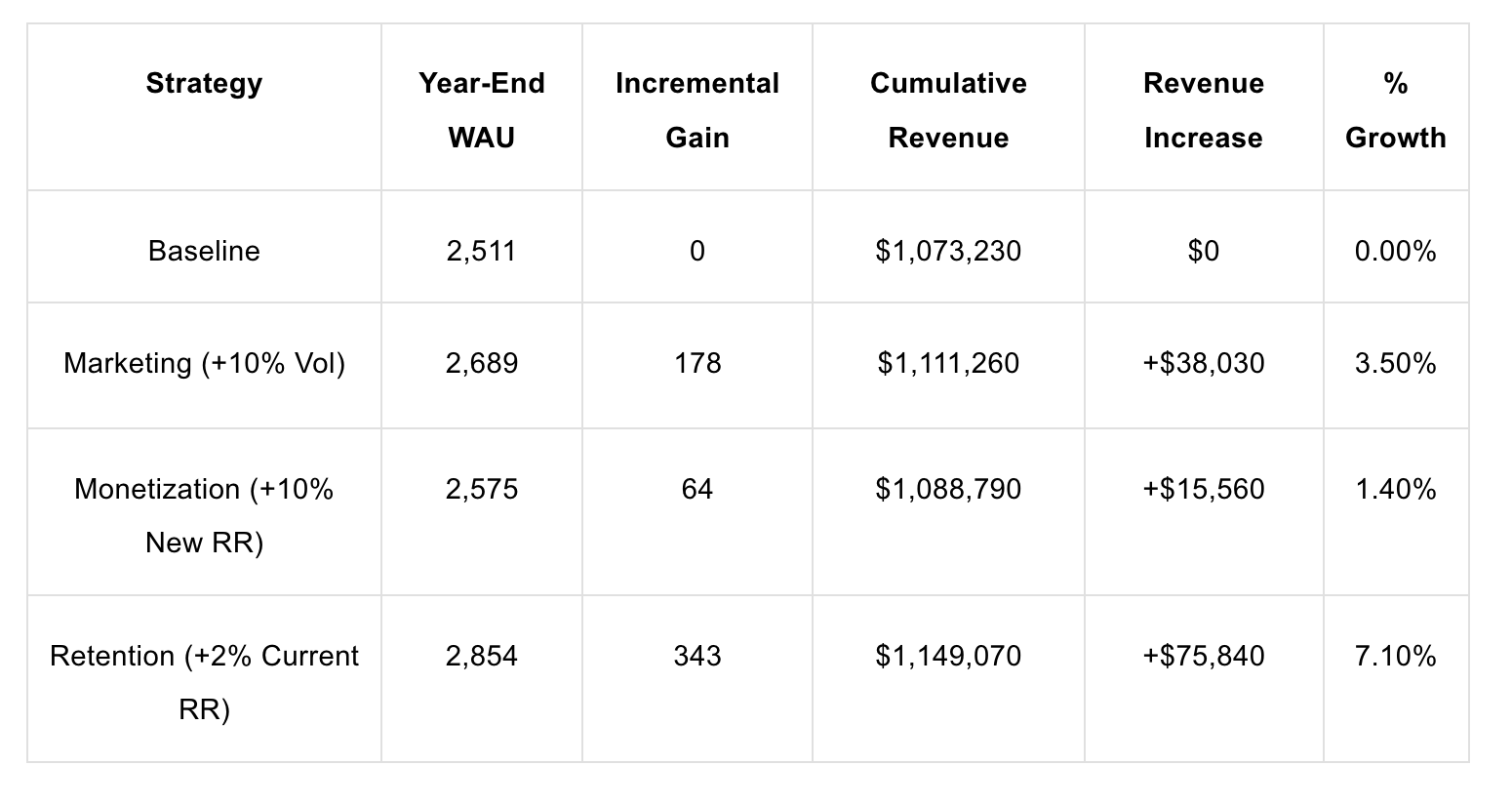
The retention strategy generated $75,840 in additional revenue — nearly double the marketing push (+$38,030). At an ARPU of $10, that 2% difference in user stickiness translates to 7.1% total growth for the year.
The simulation is based on the concepts from the famous Duolingo growth model article from Lenny's newsletter.
Reason Three: Retention Builds Acquisition Competitive Muscle
Higher LTV creates an acquisition advantage. When retention improves, you can afford a higher CAC while maintaining the same unit economics. That lets you bid more aggressively, unlock channels competitors can't touch, and scale faster under the same constraints.
Consider two companies, A and B. Both start with an LTV of $100, a target CAC of $25, and a payback tolerance of three months.
Company B improves retention, increasing LTV from $100 to $120. Keeping the same LTV:CAC ratio and payback tolerance, Company B can now afford a CAC of $30. That extra $5 per user opens up channels and scale that Company A simply can't match.
Reason Four: Retention Accelerates the Payback Period
When cohorts repay their acquisition cost faster, cash recycles faster. Faster payback means faster growth, even if nothing else changes.
To see this in action, compare two SaaS companies, Velocity and SteadyState. Both spend $60,000 per month to acquire 1,000 new users ($60 CAC).
- SteadyState has average retention. It takes 12 months to recoup that $60,000. They wait a full year before reinvesting.
- Velocity improves early-stage retention by 15%. Users stay longer and engage more, reaching break-even in just 6 months.
By month 7, Velocity has already recovered its initial $60,000 and can immediately reinvest to acquire another 1,000 users. In the same 12-month window where SteadyState acquired one batch, Velocity cycled its capital twice.
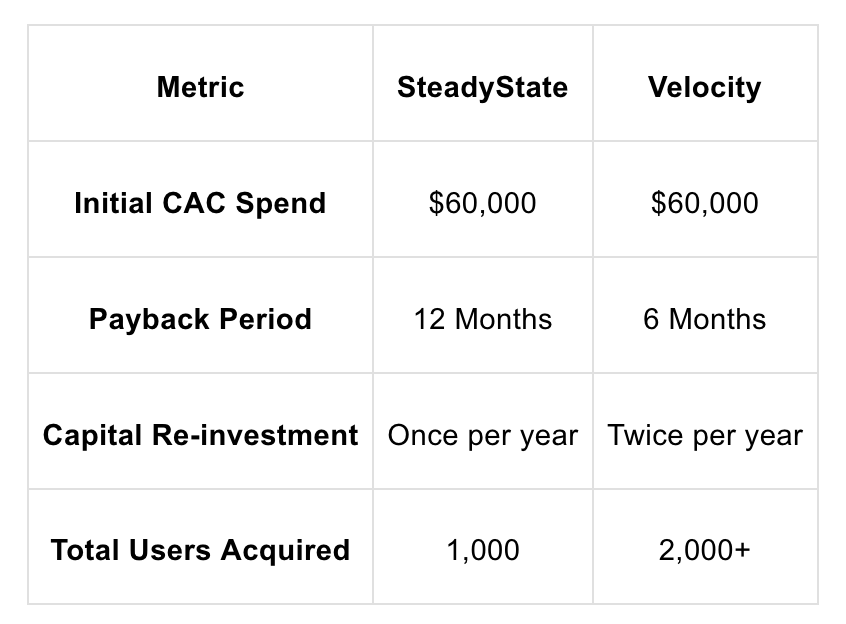
By improving retention to shorten the payback period, Velocity effectively doubled its growth rate without increasing its budget. No extra venture capital needed — just existing cash moving faster.
Putting It All Together
Retention is not just another metric on a dashboard — it's the foundation that determines whether growth compounds or collapses. It shapes acquisition efficiency, monetization potential, competitive advantage, and cash flow velocity simultaneously. When retention is strong, growth becomes self-reinforcing; when it's weak, even the best acquisition strategy is a leaky bucket.
Teams that understand, measure, and systematically improve retention don't just grow faster — they build products and businesses that last.
In the next articles and videos, we'll continue this journey and go deeper into the various stages of retention. The goal is to understand how to fill the holes in the leaky bucket — where and how to intervene. You'll learn how to improve retention through Activation, Engagement, and Resurrection using a data-driven approach:
- what activation is and how to break it into three milestones (setup, aha, and habit moment)
- how to define different levels of engagement
- how to distinguish voluntary and involuntary churn, and how to resurrect dormant users.
Stay tuned!
No spam, no sharing to third party. Only you and me.